On February 9, the American professional baseball team based in Washington, D.C., the Washington Nationals, announced the team has partnered with Terra, the open-source blockchain platform and decentralized autonomous organization (DAO). The Washington Nationals detail that the team is a “leading innovator” and is “consistently introducing new technologies to enhance the fan experience.” Washington Nationals Ink Long-Term Deal With Terra Major League Baseball (MLB) team the Washington Nationals has partnered with the blockchain platform and DAO Terra, according to an announcement published by the team on Wednesday. The deal with Terra follows a slew of sports-related deals with crypto firms, but the MLB team will be the first to partner with an open-source blockchain project. In addition to the partnership, the algorithmic stablecoin UST that’s issued on the Terra blockchain will be “accepted as a payment method at Nationals Park as early as next season.” “The Nationals continue t...
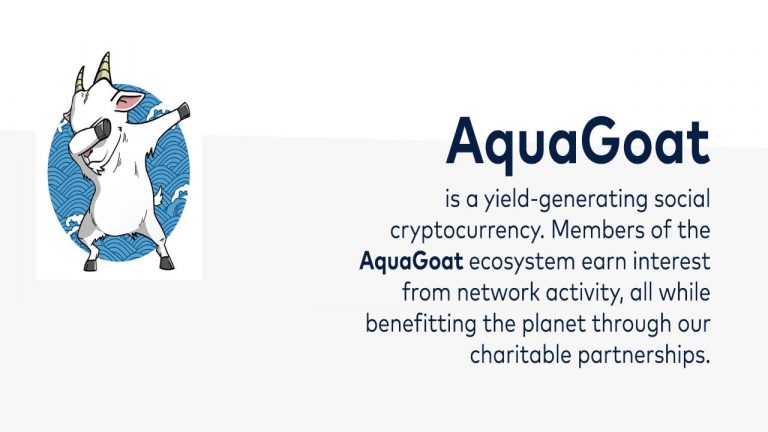
AquaGoat is an ecological social cryptocurrency with a purpose: saving the planet’s oceans. AquaGoat aims to help fund and donate to initiatives focused on cleaning and protecting the planet’s oceans and waterways, all while generating income (yield-generation) and value to its holders.
Since the project began on April 7, 2021, AquaGoat has donated to three charities: The Ocean CleanUp, an organization that develops new technologies to help rid the world of the ocean’s plastic; The Sea Shepherd Conservation Society, a group that engages in direct action campaigns to track down and stop illegal fishing enterprises; and The Blue Marine Foundation, a charity that directly addresses the environmental issues of overfishing. A little over $19,000 has been donated between all three charities so far with the intention of continuing to donate to more causes in the near future through their biweekly community polls and donation drives.
What sets AquaGoat apart from a typical charity token? Their goal is to form long term partnerships with their beneficiaries – educating them on cryptocurrency, connecting investors to in-person volunteer opportunities with them, and setting them up to be able to receive residual income through their own AquaGoat crypto wallets for years to come.
In addition to their community’s kind donations, AquaGoat has adopted a coral reef through the planting of 10 coral seedlings in the Bahamian Reef with the help of Coral Vita, an organization that spreads awareness towards the importance of coral reefs while investing in growing diverse climate resilient coral, as well as two dolphins from the Ocean Conservation Society, a group designed to conduct scientific research for ocean preservation. Between their charitable donations and their adoptions, AquaGoat also intends to spread awareness of the ongoing issue of climate change and how it affects our oceans, as well as the intricacies of the crypto market by hosting weekly education seminars. These education seminars will promote the value of investing in the crypto market while educating their audience about the wonders and important matters of ocean conservation.
Since the launch of AquaGoat, their token has attained a massive following, growing to a network of over 270,000 holders, with over 4,000 followers on Reddit, 6,000 members on Discord, 12,000 Instagram followers, 17,000 combined members and followers on Facebook, 33,000 members in the community Telegram, and 48,000 Twitter followers (not including numerous international and multilingual channels, groups, and pages developed by community members to cater to their respective countries).
Alongside their growing number of investors, the token’s community members, with the help of their dedicated administrative team, have fostered a great care for their inclusive following, all the while educating their new investors on the significance of oceanic preservation and wise crypto investing. AquaGoat is truly community-led, with a volunteer development team composed of about 35 people, five of whom make up the lead administrative team. Three of these lead administrators believe in the project so much that they resigned from their day jobs in order to work on AquaGoat full-time.
At its core, AquaGoat operates as a deflationary automated liquidity-locking and self-staking direct distribution protocol. Every transaction using AquaGoat incurs a 4% fee; 2% of all transactions is sent to liquidity, while the other 2% is directly redistributed to all holders. As transactions are made over time, the amount of tokens in the burn wallet (which acts as a holder) increases, leading to an inflating burn rate with more network activity. Consequently, the circulating supply and holder redistribution decreases over time, incentivizing early buyers and longtime holders. In contrast to conventional cryptocurrencies such as Bitcoin or Ethereum, AquaGoat runs on the Binance chain, which operates on a Proof-of-Stake system where transactions are confirmed through a liquidity pool, as opposed to the energy-intensive Proof-of-Work system where transactions are verified through mining.
Currently, AquaGoat’s donation wallet also acts as a holder and receives a portion of the 2% redistribution. In order to maximize automated charity allocation with each transaction, the token will be creating their own swaps, farms, staking, and lottery (planned for release in late July). Additionally, the Aquagoat software development team will begin rolling out applications beginning in June and have access to various APIs for internal bot and software developments. Some of these developments have already been implemented in the community Discord and Telegram.
AquaGoat recognizes how harmful man made pollution can affect the world’s oceans, ecosystems, and marine life that inhabit it. With the support of their community and through their multiple charitable initiatives, AquaGoat continues to strive for continuous growth in their token, all the while making a substantial difference in the overall health of the ocean.
At just over two months old, AquaGoat can already be purchased by interested investors on ten exchanges (with more in the pipeline coming soon): PancakeSwap, Coinsbit, SnowgeSwap, LBank, VNDC, BKEX, HotBit, ZT, Bibox and Bitrue. A step-by-step guide for brand new investors as well as more information about the project and the team behind it can be found at their website (https://www.aquagoat.finance/)
This is a sponsored post. Learn how to reach our audience here. Read disclaimer below.
Comments
Post a Comment